
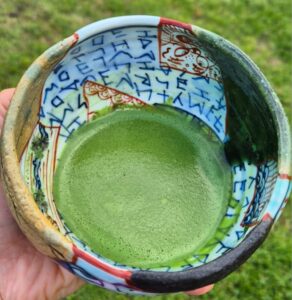
Matcha: History
In ancient China, steamed tea leaves were dried and ground into a vivid green powder and whisked into a fine froth during the Tang and Song dynasties, a preparation method known as “Diǎn Chá” (Diǎn: Whisked, Chá: Tea). In 1191, the Zen Buddhist monk Eisai brought tea seeds and the practice of powdered tea from Song Dynasty China to Japan. Building on these foundations, Japanese tea growers began developing their own methods of crafting agricultural and artisanal innovations which gradually shaped a distinct style of powdered tea that came to be known as Matcha (Matsu: Ground, Chá: Tea). Over time, matcha became central to Zen practice and was formalised within the Japanese tea ceremony (Chanoyu and Chadō/Sadō), where it evolved into an art form shaped by tranquillity, craftsmanship, and mindful presence.
Matcha among Japanese teas
Matcha is made from the tea plant “Camellia sinensis“, the same species used for all traditional Japanese green teas (Fig. 1: illustrated in the 1828 botanical work Honzo Zufu). What makes matcha unique is that the plants are shade-grown for several weeks (~20-40 days), before the youngest leaves are harvested and processed into Tenchá (flat young tea leaves that have been steamed, dried, and fully de-stemmed), and then stone-milled into an ultra-fine powder. Compared with Senchá (steamed tea) or Hōjichá (roasted tea), matcha offers a more concentrated experience because you ingest the whole leaf rather than steeping and discarding the leaves as with other teas. Its unique flavour, vibrant colour, and ceremonial role make it one of Japan’s most recognisable tea traditions.
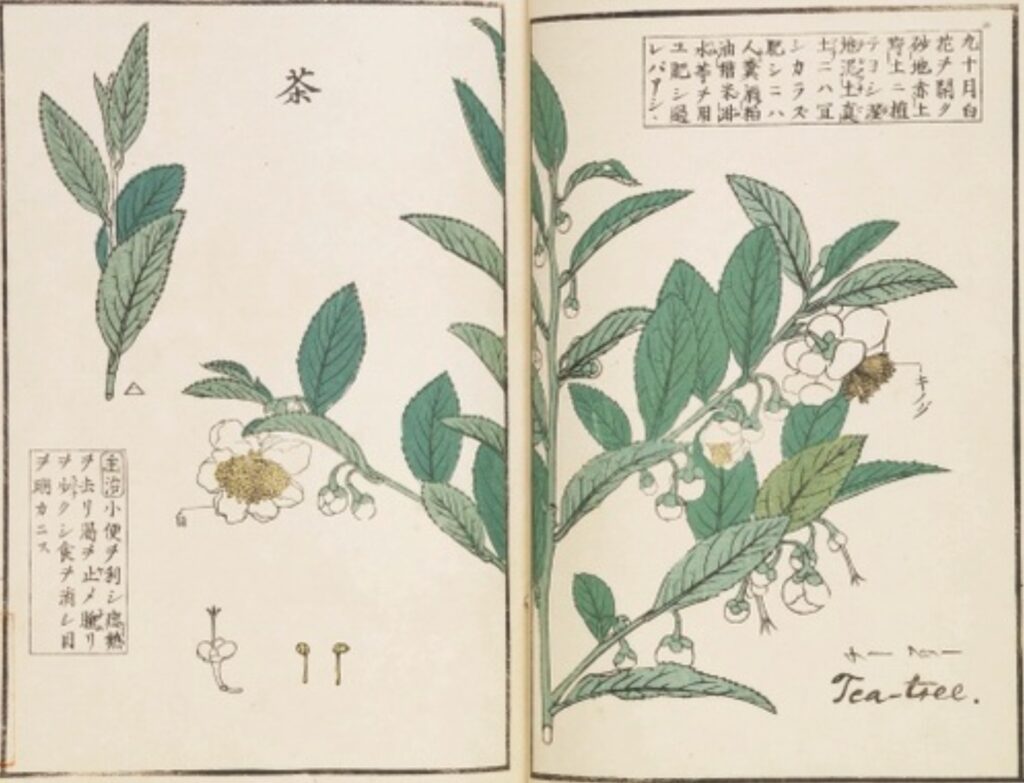
Fig 1. Camellia sinensis from Honzo Zufu, Nagasaki Museum of History and Culture.
Many matcha artisans and producers blend tea leaves from different cultivars and farms, rather than relying on a single origin or cultivar. Because harvests, weather, and growing conditions vary each year, tea blending helps maintain a consistent flavour, aroma, colour, and texture across seasons. Tea blending needs artisanal skills, where tea masters rely on their senses, knowledge, and expertise to combine various tea leaves to achieve complementary characteristics for the matcha blend.
How is matcha prepared?
Matcha can be prepared in two traditional styles: Usuchá (thin tea) and koichá (thick tea). Usuchá is whisked into a light, vibrant, frothy bowl with a delicate texture, and depending on the amount of foam, it can express various tastes, texture and aromas. Koichá uses a larger amount of the highest-grade matcha kneaded slowly into a small amount of water creating smooth, thick consistency, offering a deep, concentrated expression of the leaf and traditionally served in formal tea ceremonies.
Regardless of Usuchá or Koichá, matcha is never steeped, as whisking is essential to suspend the powdered tea evenly, and release its aroma. The rhythmic, grounded, and intentional whisking movement reflects the spirit of the way of tea.
Why does matcha wake and calm you at the same time?
Matcha’s distinctive effect comes from the synergy between caffeine and L-theanine, a combination enhanced by the shading process, which increases chlorophyll and amino acids in the leaf. Because matcha is consumed as a whole-leaf suspension, its caffeine is released more gently than coffee, while L-theanine boosts alpha-wave activity, supporting calm attention, emotional balance, and mental clarity. Modern research shows this pairing can improve focus, memory, and reaction time, creating the state often described as “calm alertness”, or “relaxed wakefulness” a quality that has supported Japanese cultural and meditative practices for centuries.
How to make matcha?
Equipment and ingredients:
- Chawan (tea bowl): Before preparing matcha, warm the chawan by swirling in hot water (70-80°C), then discard the water and dry the bowl with a soft natural cloth. A dry chawan is essential, as any moisture will cause the matcha powder to clump.
- Chasen (bamboo whisk)
- Chashaku (bamboo scoop)
- Fine double-layer sieve
- Water heated to 70-80°C
- Matcha (high-grade blended matcha for Koichá; single-cultivar or blended matcha for Usuchá)
Why does matcha wake and calm you at the same time?
Matcha’s distinctive effect comes from the synergy between caffeine and L-theanine, a combination enhanced by the shading process, which increases chlorophyll and amino acids in the leaf. Because matcha is consumed as a whole-leaf suspension, its caffeine is released more gently than coffee, while L-theanine boosts alpha-wave activity, supporting calm attention, emotional balance, and mental clarity. Modern research shows this pairing can improve focus, memory, and reaction time, creating the state often described as “calm alertness”, or “relaxed wakefulness” a quality that has supported Japanese cultural and meditative practices for centuries.
1. Usuchá: Thin tea (Fig. 2)
Sift 1-2 scoops (about 1.5-2 grams) of matcha into the warm chawan. Add 60-70 ml of hot water (70- 80°C) and whisk briskly in an M-motion until a
fine, even foam covers the surface. This style highlights aroma,
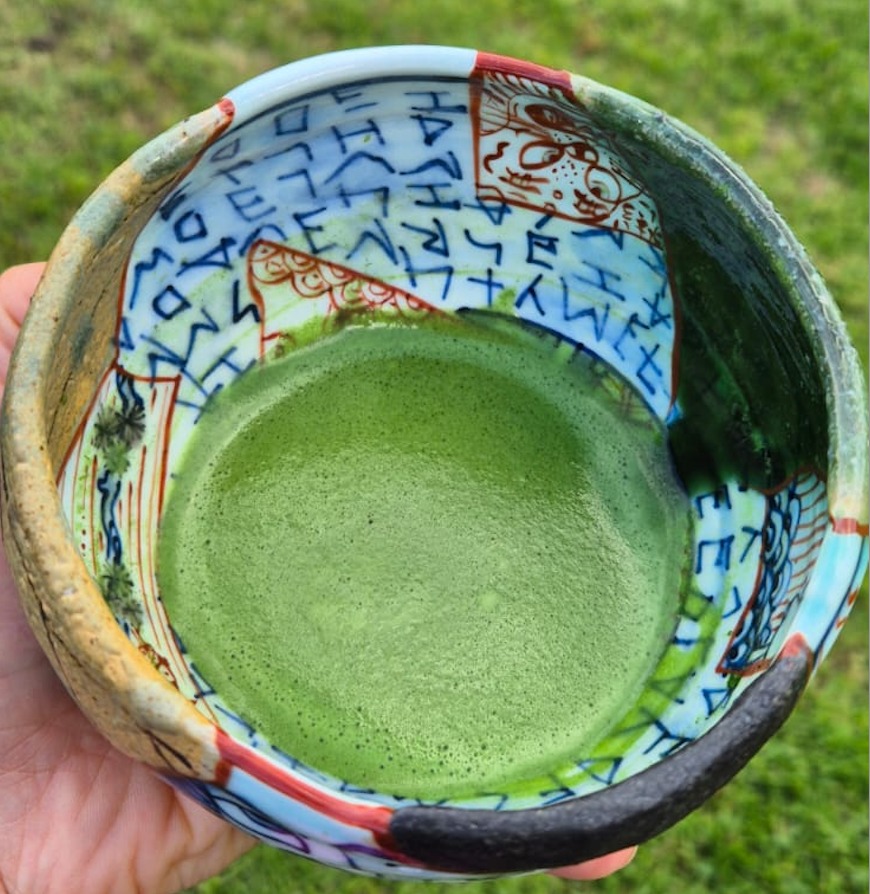
Fig 2. Usuchá
2. Koichá: Thick tea (Fig. 3)
Sift 3-4 scoops (about 4-5 grams) of high-grade matcha into the warm chawan. Add a small amount of hot water (30-40 ml) and knead slowly with the whisk until it becomes a smooth, glossy, thick paste. Koichá is rich, deep, and traditionally served in formal tea ceremonies.
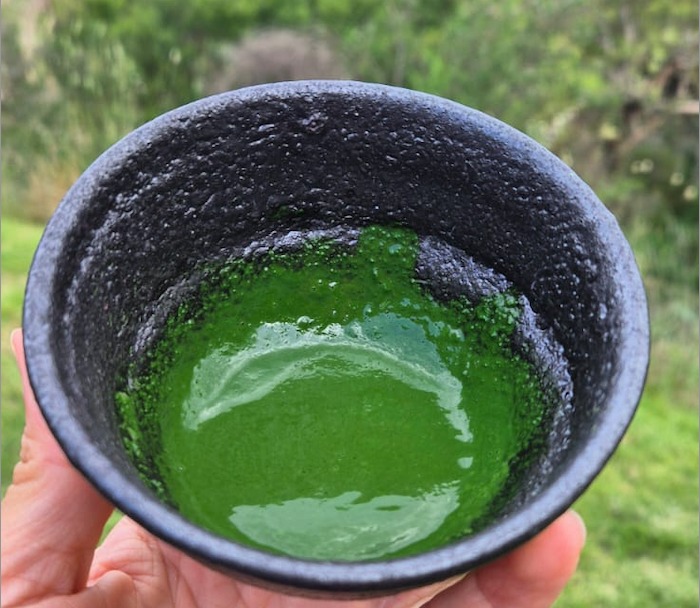
Fig 3. Koichá
Note: The term “ceremonial grade” is not a regulated standard, so don’t fall for these marketing labels. High-quality matcha is identified by clear cultivar information, harvest details, and production transparency (farm & region). Authentic matcha should have a vibrant spring-green colour, a fine talc-like texture, fresh sweet aroma, and a naturally sweet umami taste which lingers in the mouth after each sip. These qualities reflect careful shading, proper processing, skilled stone-milling, blending and storage.
The “stroke test” is a simple way to judge matcha quality (Fig. 4): drag a little powder across white paper with your fingertip. A good matcha leaves a smooth, velvety, continuous line; a rough, broken or grainy line suggests a coarser, lower-grade powder.
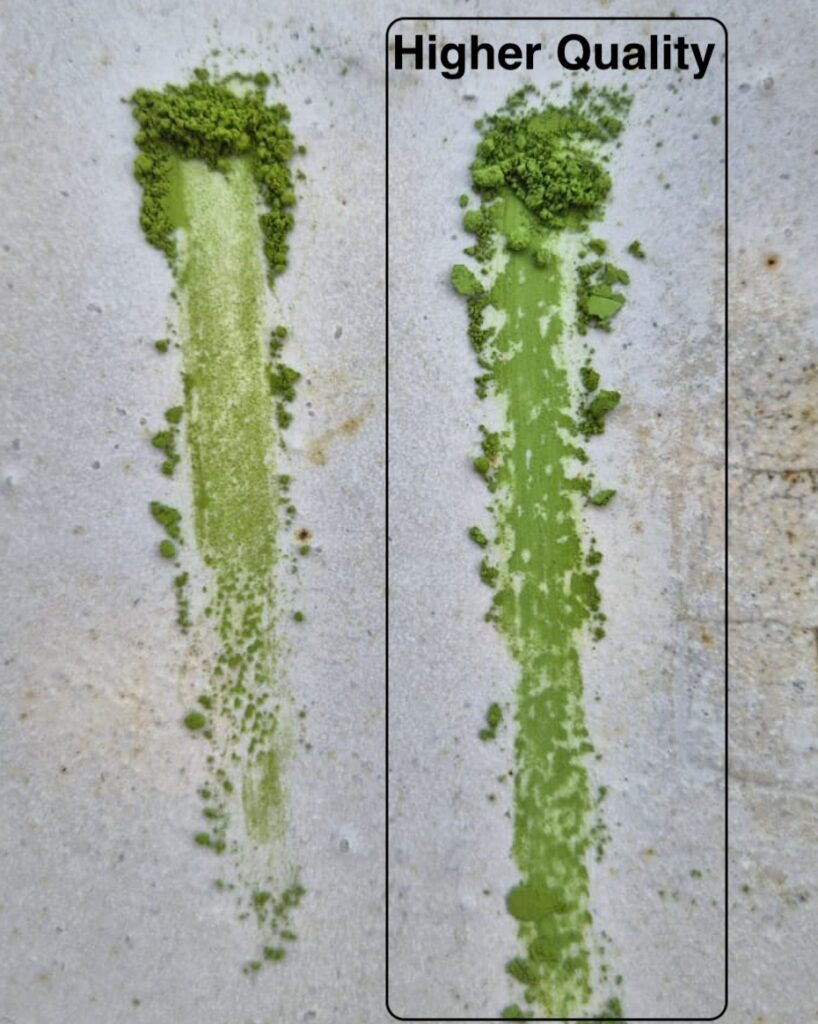
Fig 4. stroke test
Matcha in traditional Chinese and Japanese medicine
In Traditional East Asian Medicine, matcha is classified as bitter-sweet in taste with a cooling nature. It enters the Stomach, Lung, and Heart channels, where it clears heat, calms the spirit/mind (Shen), generates fluids, and aids digestion when used appropriately. It’s light, ascending quality also supports clear Yang rising to the head, which contributes to its traditional use for mental clarity and sustained focus during meditation.
Caution:
1- Iced matcha and cold matcha shakes are discouraged in Traditional Eastern Medicine, especially if you already experience digestive issues (symptoms such as bloating, indigestion, fatigue, or feeling cold easily). From a traditional medicine perspective, both the cold nature of matcha and the chilled temperature can weaken and slow digestion even further.
2- Matcha contains tannins (polyphenols) that can bind to non-heme iron, reducing its absorption. People with anaemia or low iron should consume matcha between meals, at least two hours before or after food or iron supplements, to minimize this effect.
A drink, a ritual, a connection
Matcha is a cultural lineage, a living practice linking ancient Chinese scholars, Zen monks, Japanese tea masters, and today’s artisans. Each bowl invites us to slow down, appreciate every dimension from the vessel to the aroma, savour the moment, and take part in a tradition that has travelled through centuries with quiet resilience. To whisk matcha is to share in something beautifully continuous, deeply human and a practice that slows time!
I hope you will make your own authentic bowl of Matcha and savour each sip!
get in touch
Have any questions about Acupuncture and Moxibustion treatments? Sara is available to discuss your health concerns and treatment options.
Copyright © 2023- 2026 Acupuncture Moxa Melbourne – All Rights Reserved.